
The Science Behind Canning Safety
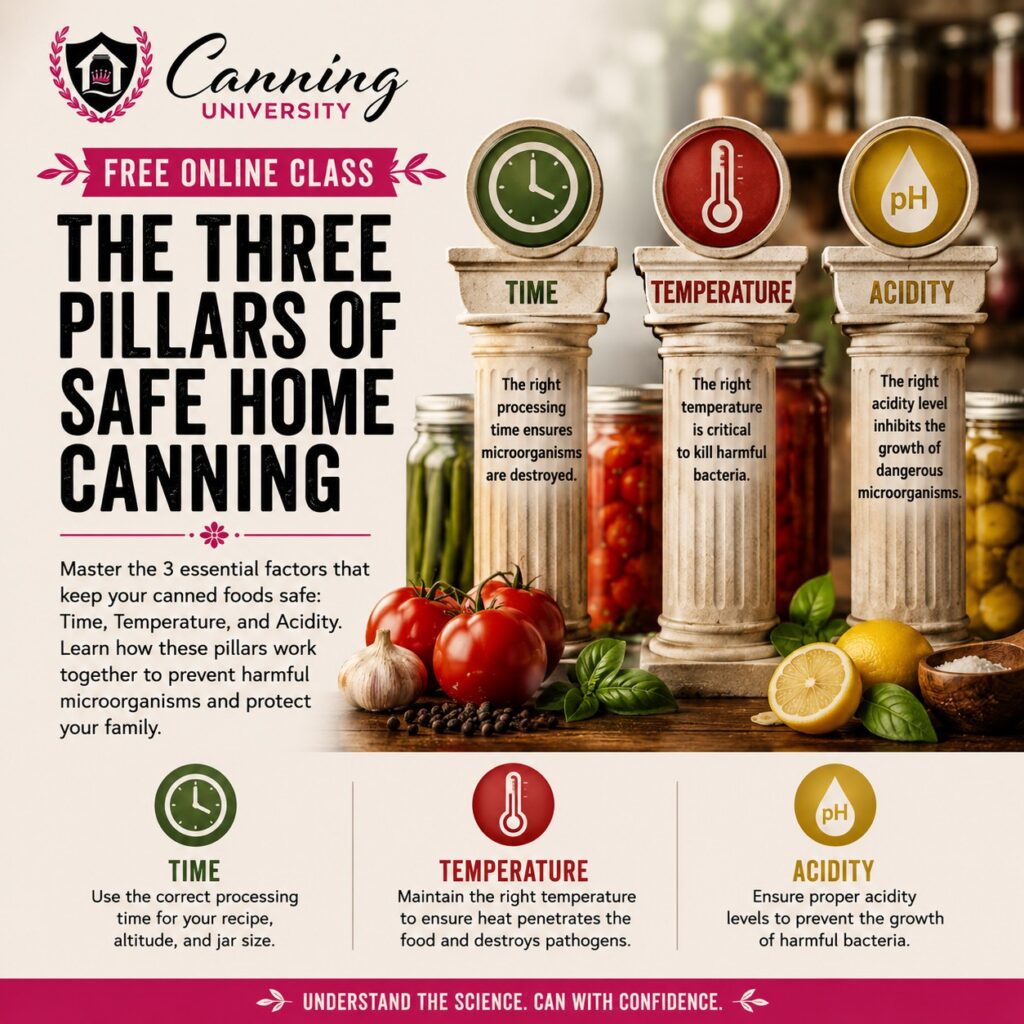
Every approved home
In this course, you’ll discover the three pillars of safe home
We’ll also explore how to properly use and calibrate a food-grade pH tester, provide a printable reference guide to common food pH values, and take a closer look at the science that forms the foundation of modern home food preservation. Whether you’re new to
By the end of this course, you’ll have a greater appreciation for the science behind safe home
Understanding Time, Temperature, Acidity & Food Density
Knowledge is one of the most valuable tools a home canner can possess. Understanding how time, temperature, acidity, and food density influence the safety of preserved foods gives you more than confidence, it gives you the ability to understand why
In this lesson, you’ll learn how these factors interact to create shelf-stable foods and why each plays an essential role in safe home food preservation. The more you understand the science, the more confidently you’ll be able to evaluate recipes, techniques, and preservation methods for yourself.
The Cumulative Science Behind Safe Home Canning
The Science, Research, and Mathematics Behind Safe Home Food Preservation (Downloadable PDF)
Every processing time, pressure recommendation, headspace measurement, and acidity requirement in home
Inside this companion guide, you’ll explore the scientific principles that shape modern home
How To Use A Food Grade pH Tester in Home Canning
A food-grade pH tester is a valuable tool for measuring the acidity of foods and recipes. While pH testing does not replace scientifically developed
In this lesson, I’ll demonstrate how to properly use a food-grade pH tester to obtain accurate readings, explain when and where to test a recipe, and share practical tips for achieving consistent results. Understanding how to measure pH is another step toward understanding the science that supports safe home food preservation.
Calibrating The pH Tester
Even the best pH meter is only as accurate as its last calibration. Before testing the acidity of any recipe, it’s important to ensure your meter is properly calibrated using the appropriate buffer solutions.
In this short lesson, you’ll learn how to calibrate a food-grade pH tester for accurate, reliable readings. I’ll demonstrate the process step by step and share a few simple tips to help you maintain your meter and achieve consistent results every time you test.
Companion Resources
Common Foods & Their pH Value Ranges (Printable Reference)
Understanding the natural acidity of foods is an important part of learning the science behind safe home food preservation. This handy reference lists the approximate pH ranges of common fruits, vegetables, herbs, meats, dairy products, and other everyday foods, giving you a quick way to compare ingredients and better understand where they fall on the pH scale.
Keep this guide in your kitchen, pantry, or
Congratulations!
You’ve successfully completed Understanding the 3 Pillars of Home
Throughout this course, you’ve explored the scientific principles that form the foundation of safe home food preservation. From understanding how time, temperature, and acidity work together to create shelf-stable foods, to learning how food density influences heat penetration, you’ve gained insight into the science behind every successful jar.
You’ve also taken a closer look at the cumulative research, mathematics, and food science that shape modern
Knowledge is one of the greatest tools a home canner can possess. The more you understand the science behind food preservation, the more confidently you’ll be able to evaluate recipes, apply safe techniques, and continue growing your skills in the kitchen.
Thank you for joining me at Canning University by The
Happy
-Diane Devereaux, The
Continue Learning
- Browse Free
Canning Classes - Explore More Canning Recipes
- Listen to The Canning Diva Podcast
- Shop Diane’s Cookbooks
- Join the Newsletter
- MAIN – Canning University HOME Page from more classes