
From Factory to Fork: lab-made proteins in the food supply
Lab-grown and precision-fermented proteins are already entering the U.S. food supply, including foodservice. As production rapidly expands, consumers are left with a critical question: where are these ingredients going, and how would we know if we’re eating them?
(I sometimes use affiliate links in my content. This will not cost you anything but it helps me offset my costs to keep creating new canning recipes. Thank you for your support.)
By Diane Devereaux | The Canning Diva®
Last updated: September 19, 2026
Lab-Grown Proteins Are Entering Foodservice. Why Aren’t Diners Being Told?
When you buy food at the grocery store, you can turn the package around and read the ingredients. You may not recognize everything on that label, but at least the information is there.
When you sit down in a restaurant, eat breakfast at a hotel, attend a catered event, order food at a stadium, eat lunch at school or receive a meal in a hospital or nursing home, that transparency largely disappears.
You don’t see the container the pancake mix arrived in. You don’t see the ingredient statement on the frozen pastries. You don’t know who manufactured the pasta, dessert, sauce, bread or prepared food used in the kitchen. And you certainly don’t know every ingredient supplier behind those products.
That matters more today than it did just a few years ago because biotechnology-derived animal proteins are no longer merely experimental. Thanks to our FDA, they have already entered commercial food production and foodservice. And consumers deserve to know where they are going.
Lab-Grown Protein Is Already a Commercial Ingredient
The EVERY Company produces an egg protein called OvoPro using precision fermentation. Instead of obtaining the egg protein from an egg laid by a chicken, microorganisms are used in a fermentation process to “produce” the protein.
Whatever terminology the biotech industry prefers, the distinction that matters to me as a consumer is simple: this egg protein did not come from an egg laid by a chicken.
And this isn’t a tiny laboratory experiment.
During the first four months of 2026, EVERY reported securing annual orders representing 550% of its entire 2025 order volume. Demand increased so dramatically that the company announced it was quadrupling its manufacturing capacity.
According to the company and food-industry reporting, that growing demand includes retail, e-commerce and foodservice channels. And that last category deserves far more attention than it has received.
Foodservice isn’t merely restaurants.
It encompasses hotels, bakeries, caterers, universities, healthcare facilities, institutional kitchens, entertainment venues and the enormous network of manufacturers and distributors supplying prepared foods and ingredients to these businesses and organizations.
EVERY markets OvoPro specifically for foods including baked goods, frozen and prepared foods, pasta, protein bars and numerous other applications. Those are exactly the types of foods frequently purchased by commercial kitchens rather than made entirely from scratch.
Now ADM Is Bringing Production to the United States
In July 2026, another major development occurred. ADM and The EVERY Company announced a partnership to begin commercial-scale production of OvoPro at ADM’s facility in Clinton, Iowa.
Something important worth noting… ADM is NOT a boutique biotechnology startup. It is one of the world’s major agricultural processors and food-ingredient suppliers. According to ADM, the partnership is intended to substantially increase OvoPro production to meet commercial demand across multiple food segments.
This is significant because precision-fermented animal proteins are moving beyond experimental launches and into industrial-scale food manufacturing in the United States.
And perhaps most ironic, ADM markets itself using the phrase “From Harvest to Home.” Yet precision-fermented animal proteins are anything but harvested in the traditional agricultural sense of the word. These proteins are produced in a laboratory rather than harvested from livestock or traditional farm production.
Frankly, the contrast is striking.
Consumers didn’t collectively invite these new ingredients into their homes, yet these new ingredients are entering the commercial food supply through manufacturers and foodservice channels serving restaurants, hospitality, education, healthcare and entertainment venues often without the person eating the finished meal ever knowing.
If this is the future of food, consumers deserve to know how their food was produced before it reaches their plate.
And that brings us to the question consumers should now be asking: Where are these lab-made ingredients being distributed throughout the U.S. food supply?
Where the Transparency Problem Begins
Here is what concerns me most.
We know these proteins are commercially produced.
We know production is rapidly expanding.
We know orders have increased dramatically.
We know foodservice is among the commercial channels purchasing these ingredients.
And we know major American food-industry infrastructure is now being brought online to manufacture them at greater scale.
What we do not have is a comprehensive public accounting identifying every food manufacturer, foodservice distributor, restaurant, hotel, bakery, caterer or institutional kitchen ultimately receiving foods made with these proteins.
Why? Because most commercial relationships aren’t publicly disclosed.
This lack of transparency makes tracing the ingredients from biotechnology companies to the dinner plate extraordinarily difficult.
The supply chain might look something like this:
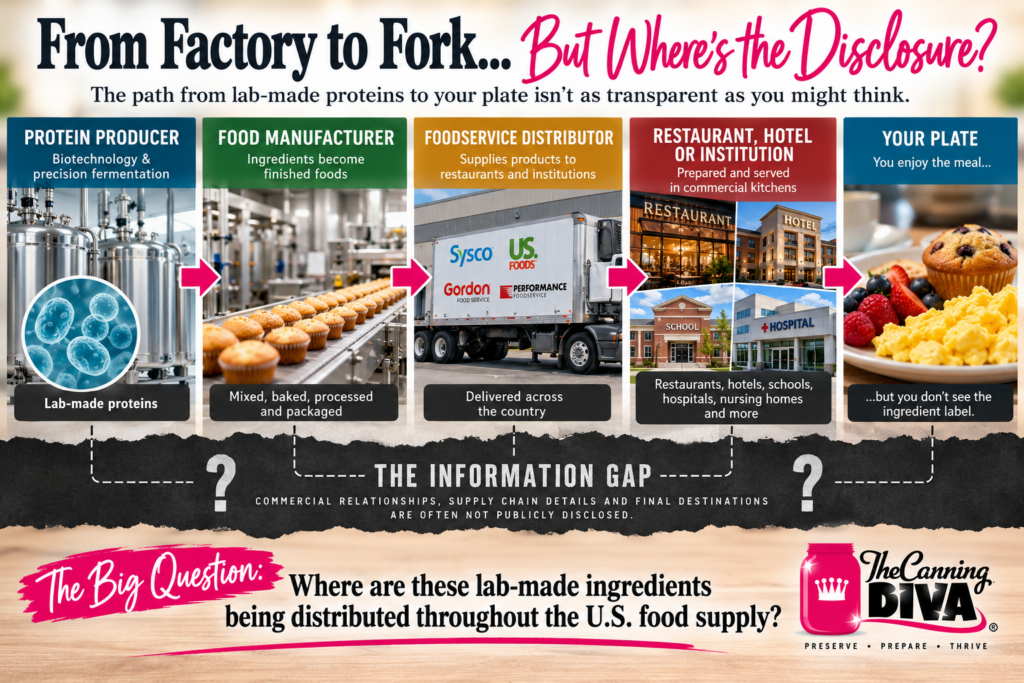
And that middle step matters tremendously. The restaurant itself may never purchase a container labeled with the biotechnology company’s name. Instead, it could purchase a commercial cake, muffin, pasta, baking mix, frozen entrée, dessert, sauce, protein product or other prepared food containing the lab-grown ingredient.
And this my friends, is the disclosure gap we need to be talking about.
Follow the Food Distributors
Companies such as Sysco, US Foods, Gordon Food Service and Performance Foodservice move enormous quantities of food through America’s restaurants, hospitality businesses and institutional kitchens. That makes foodservice distribution an important part of the supply chain to examine.
A commercial food manufacturer could purchase the protein, incorporate it into a finished food and then sell that finished product through a distributor. The distributor could subsequently deliver it to hundreds or thousands of commercial kitchens.
This interaction within the food supply chain creates an entirely different question:
Which finished commercial foods containing lab-grown animal proteins are entering foodservice distribution, which distributors are carrying them, and where are those products ultimately being served?
If biotechnology companies and food manufacturers don’t publicly disclose all of their commercial relationships, tracing the supply chain becomes considerably more difficult.
But difficult doesn’t mean we should stop asking. It means we should be asking louder.
Where Is All of This Product Going?
So where are they going?
Are they entering our schools and universities? Are hospitals purchasing prepared foods containing them? What about nursing homes and assisted-living facilities? Are hotels serving them at breakfast? Are caterers purchasing products containing them for conferences, weddings and public events?
We do not know. And that’s precisely the problem.
A 550% Increase Should Get Our Attention
The most important number in this article may be 550%. EVERY says that in only the first four months of 2026, annual orders reached 550% of the company’s entire 2025 order volume. The company subsequently quadrupled manufacturing capacity. Then came the ADM partnership for commercial-scale American production.
Consumers cannot dismiss these numbers as some futuristic technology that may appear decades from now. Commercialization is happening NOW! And the foodservice industry is explicitly part of that growth.
As production continues expanding, this transparency problem isn’t going to get smaller. It’s going to become increasingly detrimental.
So How Do We Counter This Growing Issue?
The best way to regain control is to shorten our food supply chain. Buy directly from local farmers and growers when possible, visit farmers markets, join a CSA, grow some of your own food, raise chickens if you’re able, and preserve seasonal foods for later use. The closer we are to the source, the easier it is to know how our food was produced.
We can also cook at home more often and become more selective about where we eat. Seek out restaurants that truly practice farm-to-table sourcing, not those simply using it as a marketing phrase. Ask where their meat, eggs and dairy come from and whether foods are made from scratch or purchased commercially. The same applies to schools, hospitals, nursing homes and other institutions feeding the people we care about.
We don’t have to become completely self-sufficient. We simply need to become more connected to our food again. Know your farmers, read labels, ask questions and support businesses willing to be transparent about what they’re putting on our plates.
Know the Language: What to Look for on Labels and Menus
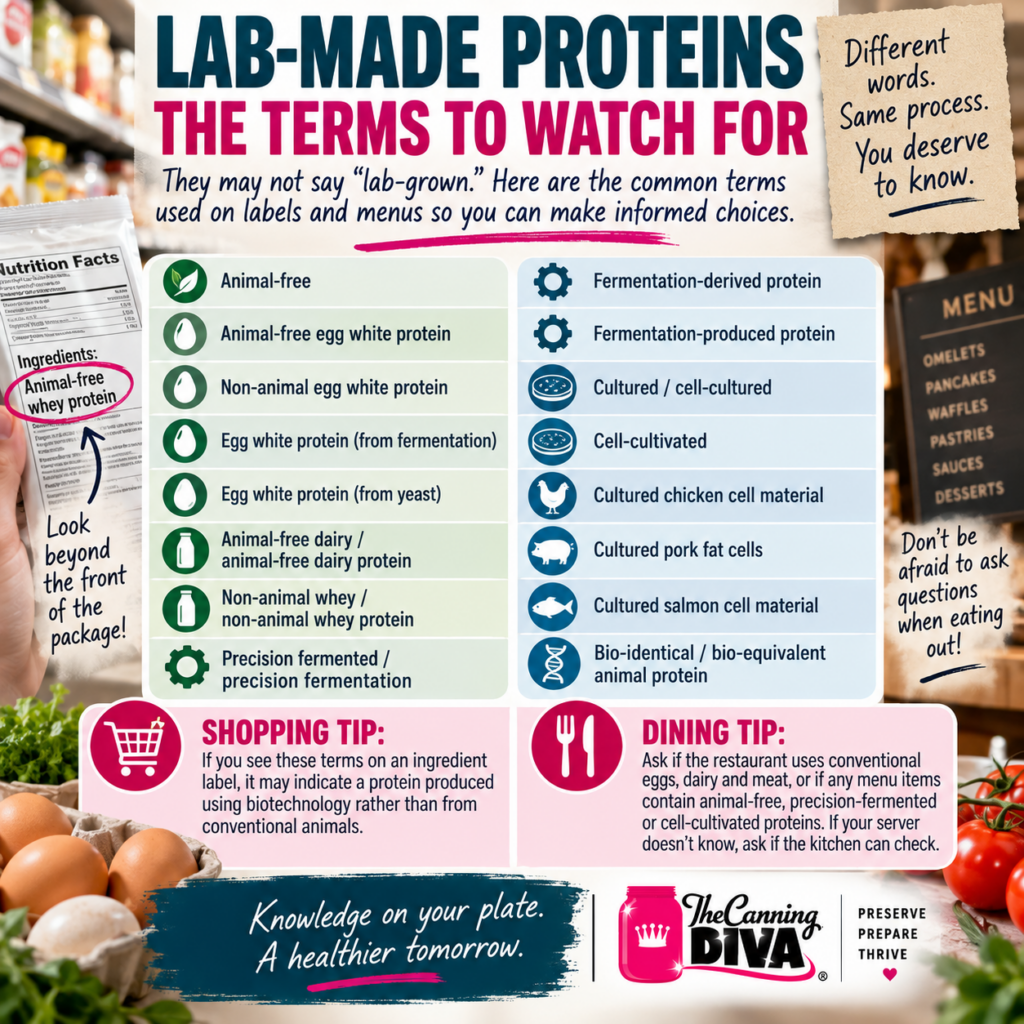
Don’t expect these products to say “lab-grown” on the label. Depending on the technology and manufacturer, consumers may encounter a variety of terms. Keep an eye out for:
- Animal-free
- Animal-free egg white protein
- Non-animal egg white protein
- Egg white protein (from fermentation)
- Egg white protein (from yeast)
- Animal-free dairy / animal-free dairy protein
- Non-animal whey / non-animal whey protein
- Precision fermented / precision fermentation
- Fermentation-derived protein
- Fermentation-produced protein
- Cultured / cell-cultured
- Cell-cultivated
- Cultured chicken cell material
- Cultured pork fat cells
- Cultured salmon cell material
- Bio-identical / bio-equivalent animal protein
One especially important distinction: “animal-free” does not necessarily mean plant-based. Precision-fermented egg or dairy proteins can still be actual animal proteins produced using microorganisms rather than obtained from a chicken or cow.
This also matters for allergies; for example, EVERY warns that its animal-free OvoPro egg protein is not suitable for people with egg allergies.
When eating out, keep it simple. Ask whether the restaurant uses conventional eggs and dairy or commercially manufactured alternatives, whether foods are made from scratch, and whether anything contains animal-free, precision-fermented, fermentation-derived, cell-cultured or cell-cultivated proteins. If the server doesn’t know, ask whether the kitchen can check the ingredient information on the original product.
Bottom line: If you see animal-free attached to a familiar animal protein such as egg, whey or dairy, don’t automatically assume it means plant-based. Ask how the protein was produced.
About the Author:
Diane Devereaux, The Canning Diva®, is an internationally recognized food preservation expert, author, and educator with over 30 years of home canning experience. She’s the author of multiple top-selling canning books and teaches workshops across the U.S. Learn more at TheCanningDiva.com.