

The Mathematics of Fear: How 89% Became a Weapon
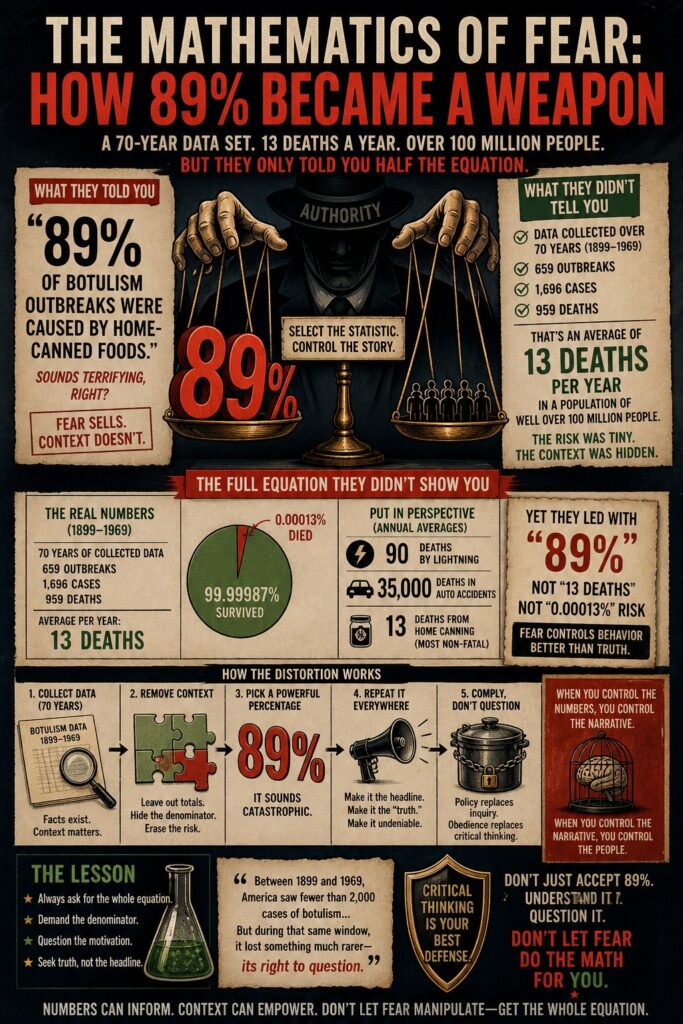
Between 1899 and 1969, fewer than 2,000 cases of botulism were recorded in the United States, averaging approximately 13 deaths per year in a population exceeding 100 million. Yet public messaging focused on a single statistic: that 89% of botulism outbreaks were linked to home-canned foods. Although accurate, this figure presented without full statistical context, omitting overall risk, population scale, and probability. This article examines botulism risk in home
(I sometimes use affiliate links in my content. This will not cost you anything but it helps me offset my costs to keep creating new
By Diane Devereaux | The
Last updated: May 5, 2026
Introduction
In the mid-20th century, a subtle but consequential shift occurred in how Americans understood risk, safety, and authority. Between 1899 and 1969, fewer than 2,000 cases of botulism were recorded in the United States—an average of approximately 13 deaths per year in a population exceeding 100 million. Yet from this dataset emerged a single, dominant statistic: that 89% of botulism outbreaks were linked to home-canned foods.

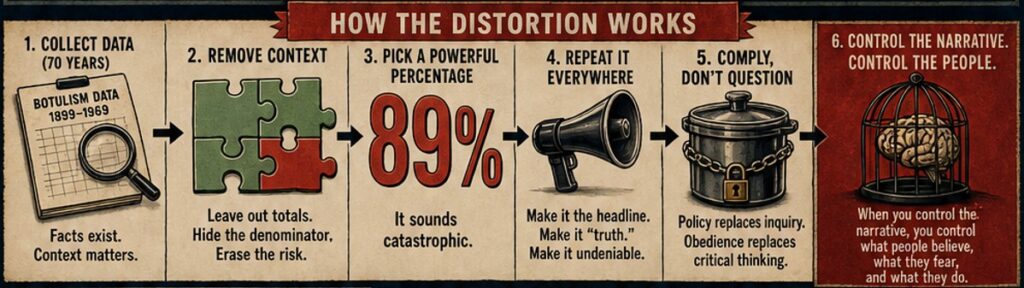
Despite being factually accurate, this percentage presented without its full statistical context. The result was not a more informed public, but a more fearful one. By emphasizing proportion over probability, and omitting the broader scope of risk, a narrative took hold—one that reshaped public perception, influenced policy, and redefined traditional practices as inherently dangerous.
This article examines how incomplete data framing can influence behavior, how percentages can obscure rather than clarify risk, and how the absence of context can transform information into a tool of persuasion rather than understanding.
The Shift from Curiosity to Control
They say history repeats itself — but sometimes it doesn’t repeat, it rewrites.
In 1946, two events quietly changed how Americans thought about food, science, and trust. That year, the U.S. Department of Agriculture published Technical Bulletin No. 930, the now-sacrosanct guide declaring pressure
At first glance, the timing seems innocent, perhaps even coincidental. But in hindsight, it marked the moment when food preservation left the hands of the people and entered the machinery of the state.
For decades before 1946, food safety was a scientific conversation, not a doctrine. Researchers like Karl F. Meyer and Edward Eddie gathered national data on botulism, analyzing outbreaks through open academic networks. Between 1899 and 1945, America recorded only a few dozen cases per decade, most tied to commercial canneries, not home kitchens.
Yet as wartime industry blurred into postwar domestic life, the line between public safety and corporate interest began to vanish. Pressure canners were suddenly marketed not as tools of convenience, but as instruments of moral responsibility. And the USDA, backed by the Bureau of Human Nutrition and Home Economics, declared that safety could be achieved only one way: under pressure.
The Silent Partnership
It’s difficult not to see the pattern. The same year the USDA dictated a single national process, the CDC was founded to track communicable diseases including botulism. By 1947, botulism was added to the list of notifiable diseases, meaning every suspected case was to be reported directly to the federal government.
The definition of safety and the measurement of failure now lived under one roof of authority. What had once been independent fields (food preservation and disease surveillance) became a closed circuit of self-affirmation.
No more open testing.
Regional adaptations disappeared.
And with them, any room for innovation.
In 1971, the CDC published “Botulism in the United States, 1899–1969,” co-authored by Eugene Gangarosa, Philip Brachman, and Karl Meyer, the very scientist whose independent data shaped the open record. The paper, based entirely on government-supplied surveillance, confirmed 659 outbreaks, 1,696 cases, and 959 deaths across seventy years.
But here’s the missing context: those numbers averaged just 13 deaths per year nationwide, a vanishingly small risk in a country whose population grew form roughly 76 million to over 200 million during that period. Still, the report’s most memorable line wasn’t the total number of cases. It was this:
“89% of botulism outbreaks resulted from home-canned foods.”
That statistic became the cornerstone of modern
The Mathematics of Fear
Percentages carry emotion. “89%” sounds catastrophic, yet it represents only about 21 home-canning incidents per year. Most of which are non-fatal, many linked to improper storage during wartime rationing.
By comparison, the same era saw:
- 90 lightning deaths per year, and
- 35,000 deaths annually from automobile accidents.
So why did “89%” become the headline and “13 deaths a year” became the footnote?
Because fear controls behavior far better than reason does.
The Illusion of Consensus
In the mid-1950s, the loop was complete. USDA pamphlets warned against “unapproved”
A new form of obedience emerged — safety by compliance.
Science had given way to policy, and policy had given way to marketing.
The Questions No One Asked
- Why did four USDA employees (Toepfer, Reynolds, Gilpin, and Taube) publish the defining document on
canning safety in 1946? - Why did it coincide perfectly with the founding of the CDC?
- Why was funding described as a “grant project” when the authors were federal employees?
- And why were their careers so difficult to trace afterward?
Perhaps because this was never just about science. It was about ownership of information.
The mid-century centralization of
This is not ignorance. It’s control by design.
The same impulse that once standardized
The Lesson Hidden in History
Between 1899 and 1969, a 70 year span, America saw fewer than 2,000 cases of botulism. But during that same window, it lost something much rarer, its right to question the science.
When authority replaces inquiry, innovation dies.
When data ownership becomes doctrine, truth becomes policy.
And when “safety” becomes a weapon against curiosity, civilization begins to sterilize not just its food — but its mind.
Because curiosity is humanity’s oldest form of rebellion.
And it may be the only thing that keeps us free.
People Often Ask
A: The 89% figure refers to the proportion of reported botulism outbreaks linked to home-canned foods, not the overall risk to the population. When viewed in full context, the data shows an average of about 13 deaths per year nationwide over a 70-year period, making the actual risk extremely low.
A: Percentages show proportion, not probability. While 89% sounds alarming, it does not reflect how rare botulism cases were overall. Without including total cases, population size, and annual averages, the statistic can create a perception of danger that is not supported by the full dataset.
A: Look beyond the headline number. Ask what the total sample size is, how the data was collected, and what the real-world probability looks like. Context is essential for making informed decisions.
A: It means using percentages to create emotional impact and omitting the broader context that defines actual risk. In this case, highlighting 89% without showing how few total cases existed can influence behavior more through fear than through informed understanding.
A: Modern CDC surveillance shows that the United States reports approximately 200–275 botulism cases per year, but the majority are infant cases unrelated to food. Foodborne botulism accounts for only about 8–10% of cases, with a median of roughly 19 cases per year nationwide, and the data is NOT exclusively home canning related. In a population exceeding 300 million, this confirms that foodborne botulism from home canning remains extremely rare.
A: No. Today, most botulism cases are infant or wound-related, not foodborne. While some foodborne cases are linked to improperly preserved foods, they represent a small fraction of total cases and an extremely low overall risk to the general population.
A: The Centers for Disease Control and Prevention (CDC) maintains national botulism surveillance reports with annual case data and breakdowns by type. Readers can explore the latest data here:
👉 https://www.cdc.gov/botulism/php/national-botulism-surveillance/index.html
About the Author:
Diane Devereaux, The